




Lung Cancer
Lung cancer is the leading cause of cancer-related mortality globally, according to the World Health Organization. Yet the treatment landscape has shifted dramatically over the past decade, with molecular testing and targeted therapies transforming outcomes for many patients. For individuals in Noida and the wider Delhi NCR region seeking the best lung cancer specialist in Noida, early evaluation and accurate molecular profiling now form the foundation of personalised care.
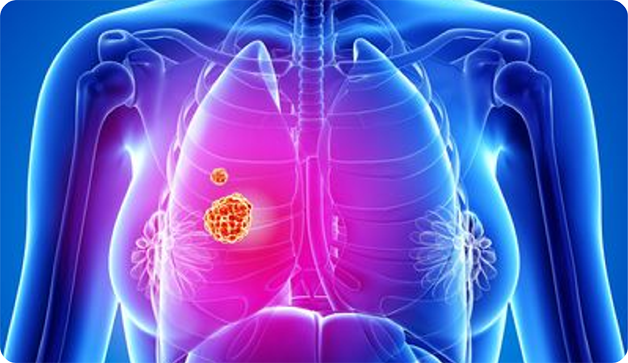


Is Lung Cancer Only Caused by Smoking?
Smoking remains the single most important risk factor responsible for the majority of lung cancer cases. However, a meaningful proportion of lung cancers occur in people who have never smoked. Non-smoker lung cancer, particularly lung adenocarcinoma with EGFR, ALK or ROS1 mutations, is well-recognised and increasingly common, particularly in women and in the South and East Asian populations. Other risk factors include passive smoke exposure, radon gas exposure in poorly ventilated homes, occupational exposure to asbestos, arsenic or diesel exhaust, air pollution including indoor biomass burning, and a personal or family history of lung cancer. The absence of smoking history should never lead to dismissal of lung cancer as a diagnostic possibility.
Types of Lung Cancer
Lung cancer is broadly divided into two major categories based on cell appearance under the microscope a distinction that fundamentally shapes treatment.
Non-Small Cell Lung Cancer (NSCLC): Accounts for approximately 85% of all lung cancers. This category is a heterogeneous group that is further divided into:
-
Adenocarcinoma: The most common NSCLC subtype, most frequently seen in non-smokers and women. Commonly harbours actionable driver mutations — EGFR, ALK, ROS1, BRAF, MET, RET and KRAS — making molecular testing essential before starting treatment.
-
Squamous Cell Carcinoma: Arises from squamous cells lining the bronchi. Strongly associated with smoking. Typically a central tumour. Less frequently harbours targetable mutations, but FGFR alterations and PD-L1 expression guide treatment.
-
Large Cell Carcinoma: A poorly differentiated NSCLC subtype diagnosed by exclusion. Grows rapidly and is treated with chemotherapy and immunotherapy.
-
Large Cell Neuroendocrine Carcinoma (LCNEC): A high-grade neuroendocrine tumour of the lung; aggressive and treated similarly to SCLC in many protocols.
Small Cell Lung Cancer (SCLC): Accounts for approximately 15% of lung cancers. Highly aggressive with rapid doubling time and early metastatic spread. Almost exclusively associated with smoking. Treated primarily with chemotherapy (etoposide-cisplatin or etoposide-carboplatin) and immunotherapy (atezolizumab or durvalumab as maintenance). Surgery has a very limited role.
Carcinoid Tumours of the Lung: Low-grade neuroendocrine tumours typical and atypical carcinoids. Generally slow-growing with better long-term outcomes than NSCLC or SCLC. Treated with surgery for localised disease; somatostatin analogues and PRRT for advanced disease.
Mesothelioma: A cancer arising from the pleural lining of the lung rather than the lung parenchyma itself. Associated with asbestos exposure. Treated differently from primary lung cancers.
Molecular subtyping and biomarker testing, including EGFR, ALK, ROS1, BRAF, MET, RET, KRAS G12C, PD-L1, TMB and STK11/KEAP1, are now considered mandatory before initiating systemic treatment for NSCLC, per NCCN and ESMO guidelines.
Early Warning Signs
When symptoms develop, they commonly include a persistent new cough or a change in a long-standing cough, coughing up blood-tinged sputum, breathlessness without obvious cause, chest pain that worsens with deep breathing or coughing, hoarseness, unexplained weight loss and fatigue, and recurrent chest infections. Any of these symptoms persisting beyond two to three weeks warrants medical evaluation, particularly in those with known risk factors.
How Is Lung Cancer Diagnosed? Biopsy and PET-CT
Diagnosis requires tissue confirmation. CT-guided biopsy is used for peripheral lung lesions accessible through the chest wall. Bronchoscopy with endobronchial biopsy or EBUS (endobronchial ultrasound) is used for centrally located tumours or lymph node sampling. Liquid biopsy, a blood test that detects tumour DNA circulating in the bloodstream, is increasingly used when tissue is limited. PET-CT plays a vital role in staging by detecting mediastinal lymph node involvement and distant metastases. Lung cancer treatment cost in Noida depends significantly on stage, treatment modality, and molecular subtype.
Treatment Options at IOCI Noida
Lung Cancer Surgery in India: For early-stage NSCLC, surgical resection, most commonly lobectomy with mediastinal lymph node dissection, remains the standard curative approach.
Radiation Therapy: Stereotactic body radiotherapy (SBRT) is an established option for early-stage lung cancer in patients who are not surgical candidates.
Chemotherapy: Used in combination with radiation for locally advanced disease, as adjuvant treatment following surgery, and as the backbone of systemic treatment for advanced disease.
Targeted Therapy for Lung Cancer: Molecular testing for EGFR mutations, ALK rearrangements, ROS1, BRAF, MET, RET, and other actionable alterations has become standard of care. Targeted agents such as osimertinib for EGFR-mutant NSCLC or alectinib for ALK-rearranged disease offer meaningful disease control with manageable side effects.
Immunotherapy: PD-L1 expression testing guides the use of checkpoint inhibitors such as pembrolizumab, now a standard first-line treatment for advanced NSCLC with high PD-L1 expression and no driver mutations.
